
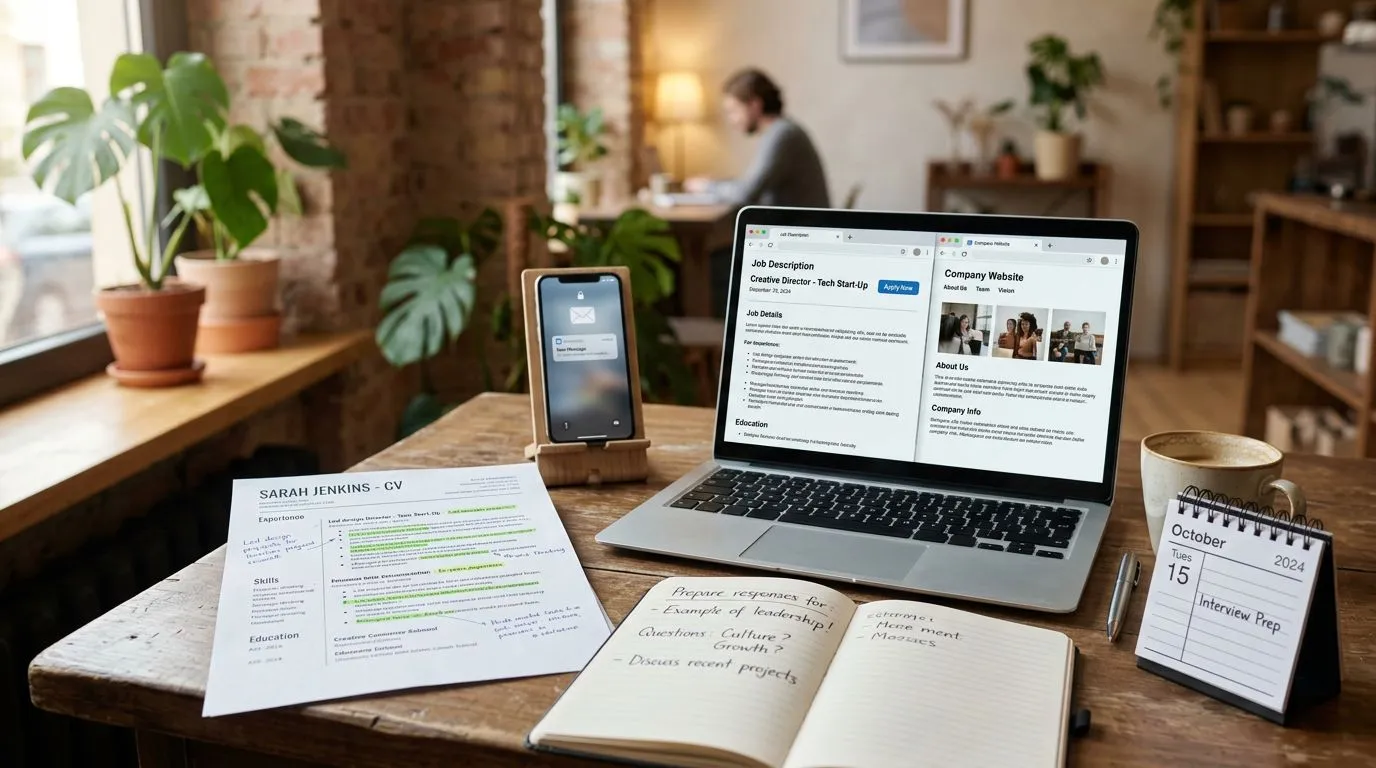
How to Prepare for a Job Interview: Research, Answers, and a Day-of Checklist
A solid interview prep plan does three jobs: it helps you understand the role, gives you answers you can actually use, and keeps the day itself calm. If you can explain what the company needs, support your claims with examples, and show up organized, you’re already ahead of a lot of candidates.
Key takeaways
- Learn the company and role well enough to explain the employer’s problem in plain English.
- Prepare short answers for common and behavioral questions so you do not improvise under pressure.
- Use a few STAR stories to show impact, not just responsibilities.
- Match your outfit, materials, and tech setup to the interview format.
- Build in time for travel, testing, and backups so the day stays calm.
Research the company and role
Knowing the company’s business, priorities, and hiring needs gives you a real edge in the interview. Indeed recommends researching the company and role thoroughly so you can speak with context and ask better questions, while UC Davis Career Center says to review the skills and qualifications line by line and match them to your own experience Indeed, UC Davis Career Center.
- Review the job posting line by line and highlight the core responsibilities, required skills, and repeated keywords.
- Study the company website, recent press releases, and recent news so you understand its products, priorities, and direction.
- Translate the posting into the employer’s problem: what results does this role need to deliver, and why now?
- Map your own experience to the role so you can name relevant wins, tools, and responsibilities without sounding rehearsed.
- Use your research to prepare smarter questions for the interviewer, such as team goals, success metrics, or upcoming challenges.
The goal isn’t to memorize marketing copy. It’s to understand what the team is trying to solve, then show in plain terms how your background fits that need. The U.S. Department of Labor notes that interviewing is both a chance for the employer to evaluate you and for you to learn about the organization and position U.S. Department of Labor.
Anticipate likely interview questions
Most interviews follow a pretty predictable set of questions, and a prepared answer almost always sounds more confident than one you make up on the spot. National Careers Service advises getting clear on what type of interview you are facing and preparing relevant experience and strengths, whether it is an in-person interview, a phone interview, or a video interview National Careers Service.
- Prepare a clear, concise answer to “Tell me about yourself” that connects your background to the role.
- Practice answers to common questions like “Why do you want this job?” “Why this company?” and “What are your strengths and weaknesses?”
- Review behavioral interview questions that ask for past examples, such as handling conflict, solving a problem, or meeting a deadline.
- Plan a short, calm response for salary expectations in case the topic comes up early.
- Keep your answers focused on the job at hand, not your whole career history.
For salary expectations, have a range or a polite deferral ready so you do not freeze if the question comes up early. If you need help deciding what is reasonable, Indeed points candidates toward market research before the conversation begins Indeed.
Prepare STAR stories that prove your skills
Behavioral questions are easier when you already have a few stories organized around real work. Rutgers Career Advancement Center recommends thinking about your skills in relation to the position and being ready to give examples that show how you used them Rutgers Career Advancement Center.
- Choose 4–6 examples that show impact, teamwork, problem-solving, adaptability, and conflict handling.
- Draft each story using Situation, Task, Action, and Result so your answer stays structured and easy to follow.
- Keep the “Action” section specific: explain what you did, not just what your team did.
- Add a measurable or observable result when possible, such as time saved, errors reduced, revenue gained, or a process improved.
- Tailor each story to the job description and rehearse both the opening line and the closing takeaway.
The STAR method helps because it keeps your answer concrete. Say an interviewer asks about a missed deadline. You can briefly describe the situation, explain your task, walk through the steps you took to recover, and end with what changed afterward. That keeps you from drifting into a long story with no point.
Know what to wear, bring, and set up for the interview type
Your presentation and setup shape the first few minutes of the interview, and those minutes matter. Harvard Business Review notes that even careful prep can fall apart if you ignore practical details like the route, timing, or the conditions you will face on the day Harvard Business Review.
| Interview type | What to wear | What to bring or set up | What to check before start time |
|---|---|---|---|
| In-person interview | Clean, simple, well-fitted clothes that match the employer’s culture and role | Extra copies of your resume, a notebook, a pen, and any requested documents | Route, parking, building entrance, and the name of your contact |
| Video interview | The same polished outfit you would wear on-site, at least from the waist up | A charged laptop or phone, notes, and the interview link or calendar invite | Camera angle, lighting, background, audio, and internet connection |
| Phone interview | Professional clothing can help your mindset even though they cannot see you | Resume, notes, and a quiet space with no interruptions | Battery level, signal strength, voicemail setup, and the correct callback number |
If you are interviewing by video, keep the background simple and test the audio before the call starts. If it is a phone interview, silence notifications and keep your notes in front of you so you are not scrambling during key questions. If it is in person, organize everything in one folder so you can reach for it without fumbling.
Handle logistics and your day-of checklist without last-minute stress
A calm interview day starts with confirmation and ends with a clear head. The U.S. Department of Labor advises treating the interview as a chance to show your experience, education, and training, which means you should spend your energy on the conversation, not on preventable confusion U.S. Department of Labor.
- Confirm the interview time, format, location or platform, and the correct contact person at least the day before.
- For in-person interviews, plan your route, parking, and buffer time so you arrive early without rushing.
- For video interviews, do a final tech check, close distracting tabs and notifications, and test your internet connection.
- Review the job description, your top stories, and 2–3 questions for the interviewer before you leave or log on.
- Arrive or join a few minutes early, take a breath, and start with a clear greeting and steady pace.
That final review should stay light, not turn into a cram session. If you spend the last ten minutes trying to relearn everything, you’ll feel more scattered than prepared. Focus on the few facts and examples you actually want to say out loud, then let the rest sit in the background.
The best interview prep is specific, practical, and repeatable. Research the role, prepare the answers you are most likely to need, and make the logistics so easy that they do not steal your attention. That way, when the interviewer asks the first question, you can focus on the conversation instead of catching up with the day.
Frequently asked questions
How early should you prepare for a job interview?
Start as soon as you get the interview invite. That gives you time to research the company, match your experience to the role, and practice answers without rushing. If the interview is competitive or technical, starting early also helps you refine your examples and questions instead of scrambling the night before.
What are the most important things to research before an interview?
Focus on the job posting line by line, the company’s products or services, recent press releases, and recent news. Pay close attention to the core responsibilities, required skills, and repeated keywords, then translate them into the employer’s actual problem. That makes it easier to answer clearly and ask sharper questions about team goals or success metrics.
What should you bring to an in-person interview?
Bring extra copies of your resume, a pen, a notebook, ID if needed, and anything the employer asked you to provide. It also helps to carry your list of questions and any work samples if they’re relevant to the role. The point is to look organized and avoid small delays that can shake your confidence.
How do you prepare for a video interview?
Test your camera, microphone, internet connection, and lighting before the interview, and make sure your background is quiet and uncluttered. Set up in a spot where you won’t be interrupted and where your face is easy to see on screen. A quick tech check can prevent problems that would otherwise distract you from the conversation.
How many STAR stories should you prepare?
Four to six solid STAR stories is usually enough for most interviews. Choose examples that show impact, teamwork, problem-solving, adaptability, and conflict handling, then tailor them to the job description. If you can tie each story to a measurable or observable result, your answers will sound sharper and more credible.